General news stories and articles from Dure Foods

Making A Powder: Dure Foods Ltd. (pt 1 of 2)

Second in a 4-part series on DURE FOODS. Taken from a recently published article by Andrew Joseph in the October 2014 issue of Canadian Packaging magazine. Photos by Cole Garside.

Packaging options available at Dure Foods include: Super Sacs; 50-lb bags; 25-lb bulk boxes; two-pound pillow pouches; 500-gram pouches; 28-gram sachets; four-inch diameter composite tins; and plastic jars.

“For us, it’s all about the blending,” states Malcolm explaining the company blends its products according to the highest food safety standards, as specified by the HACCP (Hazard Analysis Critical Control Points) and the GFSI (Global Food Safety Initiatives) of the BRC (British Retail Council) protocols. “We also have an in-house quality assurance laboratory that ensures we maintain strict quality control, while also providing us with product research and new product development capabilities.”

The Eagle Pro 240 X-Ray inspection system’s multiple inspection capabilities allow it to detect foreign objects at speeds of up to 1,000 packages per minute.

The Eagle Pro 240 X-Ray inspection system’s multiple inspection capabilities allow it to detect foreign objects at speeds of up to 1,000 packages per minute.

The manufacturing process of dry powder blending is a two-pronged attack for Dure Foods, according to plant manager Tim Laberge, a 20-year veteran with the company.

Laberge notes that while manufacturing certainly involves carefully following the developed formulas, it is even more dependent upon receiving high quality ingredients such as sugar, instant cocoa and coffee creamers—most of which arrives at the facility contained within bulk 900-kilogram tote bags.

These tote bags are designed as food-grade, with replaceable liners to ensure no cross-contamination of ingredients can occur, as well as providing a recycled life for the bag itself.

“Every ingredient that arrives at Dure Foods comes with a Certificate of Analysis that ensures that we are only receiving products of the best quality manufactured under the highest food safety standards,” relates Laberge.

These tote bags of ingredients are moved via forklift from the warehouse to the blending room. The forklifts never enter the room, instead lifting the palletized load up to an opening in the blending room wall where it is then moved by workers using hoists before being precisely weighed and added to the blend.
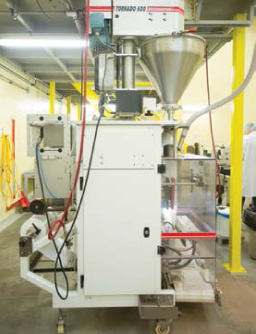
Many of the filling lines at Dure Foods utilize Arty Tornado 600 scales to smoothly feed dry powder product into the Arty 80V vertical form/fill/seal bagger, with both manufactured by Artypac Automation.

Many of the filling lines at Dure Foods utilize Arty Tornado 600 scales to smoothly feed dry powder product into the Arty 80V vertical form/fill/seal bagger, with both manufactured by Artypac Automation.

At this time lot codes are documented and blender personnel sign-off on every product ingredient added.

The dry powders are passed through one of the six Kason vibratory sifters to remove clumps before it moves into the blending stage.

“Our 100-cubic-foot double-ribbon blenders in both Canada and the U.S, provide us with the capacity to mix 70-million pounds of product each year,” mentions Laberge.

The blending times are all electronically-controlled, which ensures a consistent mix every time and then, says Laberge “every blend receives microbiological testing by a third-party laboratory.”

The Brantford facility has six production lines, including what Laberge calls an ultra-cleanroom created specifically for a customer that wanted its products packed in such a manner.

With each of the rooms set up in a similar manner to the other, each also contains the same equipment— with a couple of notable exceptions, of course.

The lines utilize an Arty 80V vertical formfill-and-seal machine manufactured by Artypac Automation Inc. of Laval, Que., to create pillow-pack applications.

The bagger also utilizes an Artypac Tornado 600 with a Vectormotion variable speed drive system to feed the product to the bagger.

Attached to the Arty 80V is a Markem-Imaje SmartDate 5 coder, that Dure Foods utilizes to apply lot code data with and without expiry date information depending on the particular product being packed to the film—before the film is unwound to form the pack on the bagger.

For product safety, the lines utilize a Fortress Technology Phantom metal detection system to check for possible foreign substances in the packed product.

The dry powder packs are then hand-packed in corrugated boxes supplied by Atlantic Packaging Products and run through a 3M-Matic top and bottom tape sealer from 3M.

Additional equipment used on the lines at Dure Foods include:

  • an Alpha Checkweigher from ALLFILL Inc.;
  • an auger filling system supplied by AMS Filling Systems;
  • Duff Packaging Machine plastic capper;
  • EBS inkjet coder;
  • two Markem-Imaje 5800 coders with two printheads apiece that can apply four different colors;
  • a model DS011E VFFS bagging system, from Viking Masek Global Packaging Technologies, featuring a Siemens Simantic Panel interface, and a Siemens Logo! TD touchscreen;
  • conveyor systems supplied by Artypac, featuring Nord motors for line speed;
  • dust collection systems, made by N.R. Murphy Ltd.;
  • stackable plastic pallets supplied by Orbis Corporation.

We hope you are enjoying our two part series! At Dure we are always striving to do better and be better.

For more information contact us here
Powder to the People!

First in a 4-part series on DURE FOODS. Taken from a recently published article by Andrew Joseph in the October 2014 issue of Canadian Packaging magazine. Photos by Cole Garside.

DURE FOODS LTD. uses advanced product inspection to formulate a winning packaging strategy for its growing co-packing business.

President Hunter Malcolm says his company provides valuable third-party services offering Flavoured Cappuccino, sugar and more, for a growing number of major national and multinational retail chains by developing and packaging unique dry powder blends for the food and beverage industry.
 
When people tend to think of the food and beverage industry, images of prime cuts of meat, bottled beverages and ready-to-eat meals immediately come to mind.
 
But despite a lack of instant recognition on behalf of Joe Public, one Ontario manufacturer and its niche market products aims to be the creamer in 
your coffee or that cup of hot chocolate perfection on a chilly evening.
 
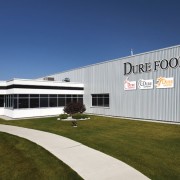
Situated in Brantford, Ont, an approximate 90-minute drive west of Toronto, the family owned Dure Foods Ltd. performs what can only be described as an efficiency solution for food and beverage suppliers across North America, offering various dry blending services for a multitude of major national and international grocery retail and fast-food chains.
 
The company describes itself as ‘large enough to count on, small enough to care’, for over 30 years providing the food services industry with quality powdered goods such as chai tea, cappuccinos, cappuccino foamers, hot chocolate, vending and reliquifying creamers and sugar, as well as a recent foray into the production of hydrators and whey proteins—all of which are available under the Dure Foods label as well as under private-label programs.
 
Founded with humble beginnings in 1978 by Scott Malcolm, he and one other employee—Chrissy Humphery, who is still with the company—worked out of a small rented space filling orders for its initial product, a liquid dish soap, which certainly doesn’t sound like a dry powdered product.
 
In fact, it was another five years before Dure Foods began manufacturing and packaging dry blends, co-packing coffee whiteners and bulk sugar, then done with a total of five employees.
 
“It was in the mid-1990s when the whole specialty coffee trend opened up. We saw an opportunity for the company to expand our talents and began developing products for this niche market,” company president Hunter Malcolm told Canadian Packaging magazine during recent visit to the company’s 53,000-square-foot facility.
 
Hunter is the son of the company founder, though Scott continues to be involved in the business on a daily basis. “The timing was great for us—just as the whiteners market began to decrease, the flavored cappuccino segment rose sharply.”
 
To create flavored coffees such as the cappuccino, the cappuccino powders would be added by coffee roasting companies to blend the taste sensation.
 With success came the necessity for growth, Malcolm notes, “so we constructed a new 35,000-square-foot facility in 2002, later adding an additional 20,000 square feet in 2006 featuring more loading docks as well as blending and packaging rooms and a total of 36 employees.”
 
In 2005 the company set-up an additional facility down in Columbus, OH, a 12 employee, 48,000-square-foot facility that also blends and packs dry powder products.
 
Nowadays, Dure Foods produces dry powder blended product for some 150 SKUs (stock keeping units), including devising custom formulizations, annually producing over four-million kilograms of powders.
 
“We put out some 20 million one-kilogram packages a years,” notes Malcolm. “And that’s just at the Brantford site.”
 
Still despite the success, the lessons learned from watching the popularity of whiteners shrink while cappuccinos rose have not been lost on Dure Foods, as it has recently begun manufacturing and offering what it calls a Lifestyle line of powders for those people with more than just a passing fancy for fitness and physical health, featuring meal and protein supplements for every stage of life.
 
“Although we are still focusing on our core strengths of dry blending, by diversifying our portfolio it provides a buffer in case one of the core markets we cater to begins to follow any type of downward trend,” explains Malcolm. “And if none ever do, then we’ve also strengthened and increased our production.
 
“It’s win-win.”
 
According to Malcolm, the number one product manufactured and packaged at Dure Foods is its hot chocolate powder.
 
He also noted that because the coffee, tea and hot chocolate powder business is seasonal—fewer people look for piping hot drinks in the summer, “the addition of the lifestyles products will hopefully help us bridge the gap.”